Hey frens,
Aavegotchi is entering a new phase.
For the past several years, Pixelcraft Studios has been the primary studio steward of Aavegotchi. We helped build the protocol, infrastructure, creative assets, games, and much of the operating layer around the ecosystem.
That model took Aavegotchi a long way.
But we no longer believe the single-studio model is the right long-term structure for Aavegotchi.
Aavegotchi is live, fully onchain, migrated to Base, and supported by years of open-source work, community participation, and DAO governance.
Now the next step is for stewardship to become more decentralized.
Pixelcraft is therefore preparing to step back from its role as the default central studio and support a structured transition toward DAO-led stewardship of Aavegotchi.
Why this is happening now
We want to be direct about the reason for this shift.
Pixelcraft was not able to turn the DAO’s last major funding round into a self-sustaining studio model or a reliable revenue engine for the protocol. That funding was deployed over the past several years toward product development, game development, infrastructure, legal and IP work, operations, contributors, integrations, and ecosystem support.
A lot was built, but the model of one studio carrying the ecosystem did not become sustainable.
Rather than keep forcing the same structure, we believe the responsible next step is to reduce Pixelcraft’s role as the default center of control and help Aavegotchi move toward a more DAO-led, multi-contributor model.
This direction is also consistent with the broader decentralization path previously discussed in AGIP133 and our longer-term DAO roadmap. But the reason for acting now is practical: the one-studio model is no longer the right structure for Aavegotchi’s next phase.
This direction also fits the broader direction of crypto regulation and protocol design. Recent market structure discussions such as the CLARITY act have placed more emphasis on reducing centralized control, limiting special permissions, and making governance and execution more transparent. We are not claiming any specific legal status under pending legislation. The point is simpler: Aavegotchi should reduce centralized dependencies where it can.
That means reducing Pixelcraft’s role as the single point of control over IP, public-facing platforms, communication layers, and ecosystem operations.
We know there will be questions about prior funding, current runway, product status, IP transfer, and what happens next. We have prepared a companion FAQ below to address those questions directly.
The transition
From June 1 through September 1, Pixelcraft will support a structured stewardship transition.
During this period, the DAO will be encouraged to organize, propose, vote, and take practical responsibility for the parts of the ecosystem that currently depend on Pixelcraft.
September 1 should be understood as a review point and transition milestone, not a magic cutoff. By then, the goal is for the DAO to have a clearer sense of what structure it wants, who it trusts to manage key responsibilities, and what level of budget or contributor support should exist going forward.
During this window, the DAO should consider:
- who should steward key public channels
- who should manage communications and community operations
- who should oversee websites, domains, documentation, and technical surfaces such as smart contracts
- who should coordinate contributors, contractors, and maintenance
- what budget, if any, should support continued ecosystem operations
- whether the DAO wants to take formal ownership of IP and trademarks
- whether some creative assets should become CC0
- what role Pixelcraft, or individual Pixelcraft contributors, should have after the transition
A full list of assets in scope for transition can be found here.
Expected transition process
The transition window is expected to move through several stages:
- Publish the transition scope, FAQ, and proposal templates
- Gather DAO feedback and identify potential stewards, managers, contributors, teams, or studios
- Draft and refine governance proposals for IP, CC0, platforms, infrastructure, and operating structure
- Vote through the DAO’s normal governance process
- Implement approved access changes, transfers, or handoffs where required
- Review the state of the transition around September 1
How the DAO can participate
During the transition window, community members, contributors, and service providers are encouraged to propose practical stewardship structures.
Useful proposals may cover areas like communications, moderation, technical maintenance, documentation, analytics, asset preservation, creative direction, ecosystem development, business development, or new product initiatives.
The most useful proposals will clearly state:
- who is responsible
- what they will manage
- what permissions they need
- what budget they request, if any
- how the DAO can review their work
- how responsibility can be transferred, renewed, or revoked
The DAO does not need to solve every part of the transition through one proposal. Some responsibilities may be handled by different teams, contributors, or working groups.
IP, CC0, and core ecosystem assets
A major part of this transition is the future of Aavegotchi IP and related assets.
Pixelcraft’s preferred direction is to support the DAO in taking more direct stewardship of Aavegotchi’s core IP, trademarks, public-facing platforms, and operational surfaces where appropriate and approved through governance.
That includes consideration of:
- transfer of Aavegotchi IP and trademarks to the AavegotchiDAO Foundation or another DAO-approved structure
- whether, and to what extent, Aavegotchi creative assets should move toward CC0
- stewardship of aavegotchi.com and related web properties
- stewardship of Discord, X, YouTube, and other public-facing channels
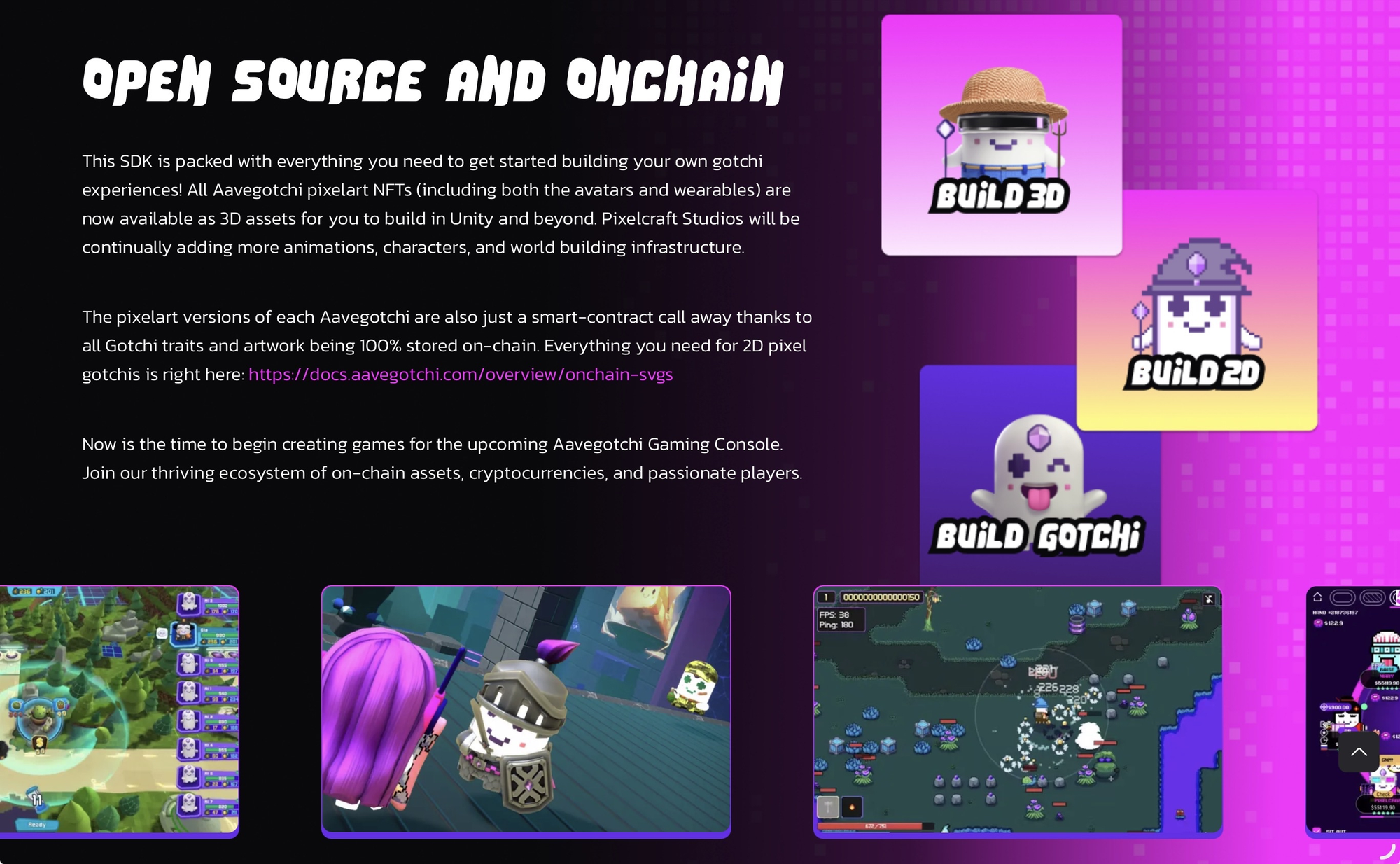
- stewardship of GitHub, NPM, SDKs, documentation, repos, and technical assets
- management of contributors, contractors, maintenance, and ongoing ecosystem support
These are separate but related decisions.
For example, trademarks need a clearly identified legal owner. Creative assets may be treated differently from trademarks. Code, SDKs, repos, and package ownership may require their own handoff process. Public channels and domains require trusted operational stewards.
To help move this forward, Pixelcraft will help provide draft materials and proposal templates the DAO can use, modify, or replace. The final decisions should belong to the DAO through its normal governance process.
Protocol control and governance surfaces
This transition is not only about branding or communications. It is also an opportunity to document and reduce practical points of centralized dependency wherever they remain.
As part of the transition process, Pixelcraft will help identify the key control and maintenance surfaces around the protocol, including smart contract admin roles where relevant, multisig structures, upgrade paths, infrastructure dependencies, repositories, indexers, and public-facing technical systems.
Where control still exists, the goal should be to move toward clearer DAO-approved rules, trusted or elected signers, transparent processes, and governance-aligned execution.
Product status
During this transition, Pixelcraft should not be assumed to be actively developing new game roadmaps for Aavegotchi.
The DAO should assume the following products are not under active Pixelcraft studio development during this period:
- Gotchi Guardians
- DeFi Dungeon
- Gotchiverse 3D
These products may still be preserved, archived, maintained in limited form, or built on by others.
But if they are to become active priorities again, that likely needs to happen through DAO-led teams, independent contributors, new studios, or new proposals.
This is part of the larger shift away from a single-studio model.
Aavegotchi should not depend on one company deciding what gets built, when it gets built, and how the ecosystem evolves.
What Pixelcraft will do during the transition
Pixelcraft will support the transition where it reasonably can.
That includes helping with:
- clarification of IP and trademark options
- proposal templates and governance materials
- technical documentation and handoff
- access paths for DAO-approved stewards or managers
- transition of key platforms, accounts, repos, and operational assets where appropriate
- continuity support during the June 1 to September 1 transition window
Pixelcraft contributors may also continue participating in the ecosystem as builders, holders, community members, or future proposal authors.
But the important distinction is this:
Pixelcraft should not automatically return as the lead studio sitting at the center of Aavegotchi by default.
If Pixelcraft contributes again after this transition, the healthier model is for Pixelcraft to participate as one contributor or studio among others inside a DAO-led ecosystem.
What happens by September 1
By September 1, the DAO should ideally have clearer answers to several questions:
- Does the DAO want to accept stewardship of the IP and trademarks?
- Does the DAO want some creative assets to become CC0?
- Who should manage websites, domains, socials, Discord, GitHub, NPM, docs, and SDKs?
- Who should coordinate day-to-day communications and ecosystem operations?
- What budget, if any, should support continued maintenance?
- What role should Pixelcraft or individual Pixelcraft contributors have going forward?
Several outcomes are possible.
The DAO may approve a clear stewardship structure, in which case Pixelcraft will help implement approved transfers or access changes where required.
The DAO may approve some parts of the transition but not others, in which case the handoff may happen in stages.
The DAO may fail to approve a clear structure, in which case some services may be reduced, archived, or no longer actively maintained.
Any transfer of company-controlled assets would still need to happen through the appropriate formal steps.
Transition resources
Read the full Transition Scope and Details document here.
Read the draft stewardship proposal template here.
Join the DAO discussion here.
The next chapter
Aavegotchi has always been bigger than one company.
It is a protocol, a brand, a community, a culture, a set of onchain assets, and a long-running experiment in crypto-native ownership.
People will have different views on what worked, what did not, and what should happen next. That is normal.
What matters now is that Aavegotchi still has a living protocol, a real community, and an opportunity to become more credibly DAO-led.
The next phase should be more decentralized, more community-owned, and more open to multiple contributors, studios, builders, and stewards.
From June 1 through September 1, we encourage the DAO to use this window to organize, propose, lead, and take meaningful responsibility for Aavegotchi’s next phase.
Important Links:
FAQ: Aavegotchi’s DAO-Led Stewardship Transition
What is happening?
Aavegotchi is moving beyond the single-studio model.
For the past several years, Pixelcraft Studios has been the primary studio steward of Aavegotchi. Going forward, we believe Aavegotchi should move toward a more DAO-led, multi-contributor model, where Pixelcraft and individual Pixelcraft contributors may still participate, but not as the default center of control.
From June 1 through September 1, Pixelcraft will support a structured transition period so the DAO can organize, propose, vote, and decide how key stewardship responsibilities should be handled.
Is Pixelcraft shutting down?
No. This is not a formal company shutdown announcement.
Pixelcraft is stepping back from active studio-led development and from its role as the default central steward of Aavegotchi. The company will use the transition window to support handoff where reasonably possible and reassess what role, if any, makes sense after the summer.
Why is this happening now?
Pixelcraft was not able to turn the DAO’s last major funding round into a self-sustaining studio model or reliable protocol revenue model.
That funding was deployed over time towards product development, game development, infrastructure, legal and IP work, operations, contributors, integrations, and ecosystem support. This included work around Geist, Gotchi Guardians, Rektless, Gotchiverse development, dapp management, Base migration management, and normal company maintenance.
A lot was built, but the model of one studio carrying the ecosystem did not become sustainable.
Rather than keep forcing that structure, we believe the responsible next step is to reduce Pixelcraft’s role as the default center of control and help Aavegotchi move toward a more DAO-led, multi-contributor model.
What happened to the funding Pixelcraft received from the DAO?
The funding was used over time to build and operate Aavegotchi-related products, infrastructure, integrations, and company operations.
At the time the funds were initially transferred, Pixelcraft’s burn rate was roughly $300K per month. After Geist was terminated, we reduced burn to roughly $200K per month, then lower from there. As of now, Pixelcraft’s operating runway is limited, with remaining resources primarily focused on supporting critical infrastructure and transition-related costs during the handoff period.
This transition is not being proposed because there is a large unused reserve waiting to be distributed. It is being proposed because the current single-studio model is no longer sustainable.
Can the DAO ask for the money back?
Prior funding was deployed over time toward development, infrastructure, operations, contributors, integrations, and ecosystem support.
The transition is not structured as a return of unused funding. The practical path forward is to decide what happens next: who stewards the IP, what becomes CC0, who manages key platforms, who maintains infrastructure, and what budget, if any, the DAO wants to allocate for future operations.
How much funding does Pixelcraft have left?
Pixelcraft has limited remaining operating runway.
The remaining resources are being prioritized toward critical infrastructure, transition support, and remaining company obligations during the June 1 to September 1 transition window.
What happens to the Pixelcraft team?
Coderdan, goldenXross, and Xibot plan to remain active community members through this transition and beyond.
We are not stepping away from Aavegotchi. We are stepping back from the old model where Pixelcraft is automatically expected to be the lead studio and default operator for everything.
After the transition, individual Pixelcraft contributors may continue participating as builders, holders, community members, contributors, or future proposal authors.
Who will lead development after the transition?
That is one of the key decisions for the DAO.
Development may continue through DAO-led teams, independent contributors, new studios, contractors, or specific funded proposals. The important change is that development should not depend by default on Pixelcraft acting as the central studio.
If the DAO wants certain products, tools, or infrastructure maintained or expanded, it will need to decide who should lead that work and what budget, if any, should support it.
Who will manage socials and communications?
During the transition window, the DAO should decide who will manage public communications and community-facing operations.
This includes Discord, X, YouTube, announcements, moderation, public messaging, community updates, and related communications surfaces.
Pixelcraft can help with handoff where appropriate, but the long-term structure should be decided through DAO process.
Is this the end of Aavegotchi?
No.
Aavegotchi is live, fully onchain, migrated to Base, and supported by years of open-source work, community participation, and DAO governance. The protocol, NFTs, assets, culture, and community still exist.
This is not the end of Aavegotchi. It is a transition away from dependence on one studio.
Is this a DAO takeover?
Not exactly.
This is not an adversarial takeover. Pixelcraft is intentionally creating room for the DAO to take more direct responsibility over Aavegotchi’s future.
The DAO will be able to decide whether it wants to take on more stewardship, what structures it trusts, who should manage key responsibilities, and how much budget should support continued operations.
A better way to describe it is: a transition toward DAO-led stewardship.
Will ownership of the Aavegotchi IP be transferred to the DAO?
Pixelcraft’s preferred direction is to support transfer of core Aavegotchi IP and trademarks to the AavegotchiDAO Foundation or another DAO-approved structure, subject to formal governance and implementation steps.
The DAO will need to decide whether it wants to accept that responsibility and how the IP should be stewarded going forward.
What about CC0?
The DAO will need to decide whether, and to what extent, Aavegotchi creative assets should move toward a CC0 model.
Trademarks and creative assets are related but not identical. Trademarks need a clearly identified legal owner. Creative assets may be opened more broadly if the DAO chooses that path.
The exact structure should be decided through governance.
What assets are in scope for transition?
The transition may include:
- Aavegotchi IP and trademarks
- Aavegotchi creative assets
- aavegotchi.com and related web properties
- Discord, X, YouTube, and other public channels
- GitHub, NPM, SDKs, documentation, repos, and technical assets
- contributor coordination, contractor management, maintenance, and ecosystem operations
Some of these require legal transfer. Some require operational handoff. Some require governance approval. Some may require trusted stewards or managers.
Is there any cost to the DAO for the IP transfer process?
Pixelcraft currently expects to cover the core legal cost of the trademark transfer, estimated at approximately $4,000 USD.
Separate from the transfer itself, the DAO may need to fund ongoing infrastructure and maintenance costs after the transition window. This could include services such as hosting, subgraphs, tooling, domains, technical maintenance, moderation, communications, and contributor support.
What happens to Gotchi Guardians, DeFi Dungeon, and Gotchiverse 3D?
During this transition, Pixelcraft should not be assumed to be actively developing new game roadmaps for:
- Gotchi Guardians
- DeFi Dungeon
- Gotchiverse 3D
These products may still be preserved, archived, maintained in limited form, or built on by others. But if they are to become active priorities again, that likely needs to happen through DAO-led teams, independent contributors, new studios, or new proposals.
Are NFTs, GHST, Gotchis, wearables, parcels, or listings being changed by this announcement?
No.
This announcement does not require holders to take any action. Aavegotchi’s onchain assets continue to exist. Existing NFTs, GHST, wearables, parcels, Gotchis, and other ecosystem assets are not being migrated or altered by this post.
Any formal transfer of IP, accounts, infrastructure, or stewardship authority would need to happen through the appropriate governance and implementation steps.
Do holders need to connect wallets, migrate assets, or sign anything?
No.
Do not trust urgent wallet connection links, migration requests, or “claim” links related to this transition.
Pixelcraft and the DAO will not ask users to urgently migrate assets or sign transactions as part of this announcement. Formal proposals and implementation steps should be verified through official Aavegotchi governance and communication channels.
What happens between June 1 and September 1?
The transition window is meant to give the DAO time to organize around practical stewardship.
During this period, the DAO should ideally:
- discuss the transition scope
- identify potential stewards, managers, contributors, or teams
- draft and refine governance proposals
- decide what should happen with IP, trademarks, CC0, websites, socials, GitHub, NPM, docs, SDKs, and infrastructure
- determine what budget, if any, should support continued ecosystem operations
- begin implementing approved handoffs or access changes where appropriate
September 1 is a review point and transition milestone, not a magic cutoff.
What happens if the DAO does not approve a clear stewardship structure?
If the DAO does not establish a clear structure, some services may be reduced, archived, or no longer actively maintained.
Any transfer of company-controlled assets would still need to happen through appropriate formal steps. Pixelcraft will support what it reasonably can during the transition, but Aavegotchi should not depend indefinitely on Pixelcraft remaining the default operator.
What happens if the DAO does approve a stewardship structure?
If the DAO approves a clear stewardship structure, Pixelcraft will work to support implementation where required.
That could include transfer or handoff of relevant assets, accounts, documentation, access paths, and operational responsibilities, depending on what the DAO approves and what is legally or technically feasible.
Will Pixelcraft continue receiving revenue from Aavegotchi after transferring IP or stepping back?
This should be addressed as part of the formal transition proposals.
If IP, platform stewardship, or operating responsibilities move away from Pixelcraft, then any revenue-sharing expectations or arrangements tied to Pixelcraft’s prior role should be reviewed and clarified through DAO governance.
The goal is to avoid ambiguity: future revenue, responsibilities, and costs should match whatever stewardship structure the DAO approves.
Could Pixelcraft return after September 1?
Possibly, but not in the same default role. If Pixelcraft contributes again after this transition, the healthier model would be for Pixelcraft to participate as one contributor or studio among others inside a DAO-led ecosystem, not as the automatic lead studio sitting at the center of everything.
Why not just keep Pixelcraft as the main studio?
The single-studio model did not become self-sustaining.
Aavegotchi needs a structure that can survive and evolve without depending on one company to fund, build, communicate, maintain, and coordinate everything by default.
What kind of contributors or teams should step up?
The DAO may need contributors or teams for:
- technical maintenance
- frontend and dapp work
- smart contract and infrastructure support
- documentation
- community management
- moderation
- social media and communications
- analytics
- ecosystem development
- business development
- art, lore, and creative direction
- product experiments
- preservation and archiving
The transition creates room for new leaders, teams, studios, and contributors to emerge.
What is the main thing the DAO needs to decide?
The DAO needs to decide whether it wants real stewardship responsibility.
That means not just voting in theory, but deciding who manages the IP, who controls public channels, who maintains infrastructure, who coordinates contributors, what budget supports operations, and what Aavegotchi should become after the single-studio model.
Official Resources
Official Website: https://aavegotchi.com/
Marketplace: https://www.aavegotchi.com/baazaar/aavegotchis
Aavegotchi Art: https://www.fakegotchis.com
Community:
Discord: https://discord.gg/aavegotchi
Telegram: https://t.me/aavegotchi
YouTube: https://www.youtube.com/c/Aavegotchi